Why A Slow Yes Is Better Than A fast no.
Imagine yourself as a business, sponsorship or partnership developer walking into a prospect’s office
with nothing specific to sell – no goods, no services, no proposal or leave-behind, nothing.
All you have is you.
It sounds scary, doesn’t it? The instinct to fill silence with a pitch or your story is super strong.
But it shouldn’t be, because the clear signal you are sending is, I’m not going to presuppose what your
challenge is. I’m going to come and listen and probe and build a rapport before I go anywhere near
offering a solution.
The simple fact is you can’t solve a problem until you know what it is and you can’t sell anything to
anyone until you know what they want to buy.
That’s why, for over 2 decades in brokering big partnerships we never sent out a proposal, because it
either presupposes what the prospect’s challenge is, or worse, just talks about us and what we have to sell. Either way it doesn’t solve their problem so why would they choose us?
Great business relationships are built on iterative understanding, not transactional selling. It’s about building a knowledge base of each other through listening, understanding and relationship development.
And big partnerships are built on solving big problems. If you want to move up from transactional deals, then you need to move away from being transactional.
Successful business developers are like artisan bricklayers. They plan their project, know every part of the landscape, invest valuable time in laying the foundations (where it’s hard to see progress), then build the relationship brick by brick. It takes time for it to become visible, but when it does, it’s solid and well supported.
The more time you spend with a prospect the more they commit to you. It’s an emotional investment for them - the more they invest, the harder it is to walk away.
That’s why we say: A slow yes is better than a fast no.
Process Is Your Safety Net.
We’ve run an online sponsorship academy (https://www.sponsorship.academy) for well over 10-years
now. It’s based on our two decades of building impactful partnership strategies and brokering some
of the biggest deals in the arts, culture and community sectors (the hard sectors where funding is tight,
values compete and sport simply takes the lion’s share of available funds).
It has a lot of content – theory, maxims, case studies, downloads, etc, and we’ve gradually chiselled it
down over the years to a simple acronym – DRIVER.
Disrupt. Positively disrupt your prospect to earn their attention and a meeting.
Research. Uncover what actually matters to them, before and during that meeting.
Imagine. Build real options for what you could do together and bring them to the table.
Validate. Test those options against the people who actually have to say yes.
Evaluate. Close in on the best option and get agreement.
Realise. Make it real. Lead the contract process and set the tone the partnership will run on.
It works for two reasons. It breaks development into steps, so you build a deal rather than propose one, and it gives you a decision point at every stage, so you can step forward, step back, or walk away, instead of finding out too late that the deal was never going to land.
You’ll also see that nothing is ‘proposed’ until you have all the knowledge you need and all the stakeholders engaged. If you can’t get to that point, then you respectfully opt out of further discussions.
As a small but very powerful example, we always deploy the process of a ‘reverse brief’ after a first meeting, i.e., the next morning after you have met a prospect, you send them an informal ‘record’ of that meeting, reflecting what you heard from them, their challenges and any insights that may have come up. You then ask them to flick it back with any corrections or additions. It may seem innocuous, but in fact without proposing anything, you have got them to invest a little bit more in you. A bit more time, a bit more emotional commitment. It’s simple but it works.
Any sort of business development involves lots of unknowns, simply because you are only half of the equation. So, it’s critical to pace it out, gather information, build rapport and trust. A good process simply allows you to know where you are, what to do next or what to rectify. DRIVER does exactly that, it creates a safety net in what can otherwise be a risky high wire act.
Why Dollars Don’t Always Make Sense.
As partnership developers, we’ve long been trained to prioritise the value of cash in any deal. The mighty
dollar just has an aura around it that is hard to argue against. And let’s agree, sales targets just aren’t
measured in cows and bread these days!
Maybe because you cannot easily split a large item, like a cow, into small pieces to buy a loaf of bread.
Makes sense. Bring on a common currency.
Until you realise that our common currency is not distributed evenly. We don’t all have the same amount
to spend.
Whether we like it or not, western societies now value money more than almost anything else. We work
for it, we invest it, we retire with it. We count our wealth in it. In a perverse way we even assume it makes
us happier (think buying tatts). Instead of acting as a servant to a transaction our common currency
has created a power base of its own and it’s selective in where it resides in abundance
(think stockbrokers versus early-childhood educators).
When it is used in any exchange, the person with more money has the whip hand, most particularly if the person receiving it has much less and needs it to function. It creates an unequal relationship, a power imbalance.
The fact is, for many if not most of us, money is a scarce commodity. So instead of it serving us and making our transactions easier, we now serve it. This mindset does not assist in building great partnerships or doing prudent deals.
But there might be a lot more of something else to help us, a different currency, a more abundant currency available, if we are patient in our prospecting - in seeking it out.
A simple example. A colleague pitched a $100K cash sponsorship to a corporate, and got knocked back, but after further discussions, ended up with $250K of genuine media spend. The media was very useful to them and saved at least that in budget relief. The corporate was happy because they had an abundance of bonus media. Cows for bread. Simple.
Another example, a local food rescue business near and dear to us can extract 6 figure equivalent value in product from manufacturers and supermarkets, but cash support is largely off the table. The product is simply more abundant for the businesses than the cash and they value cash differently.
So, move away from chasing our legal tender and seek out true abundance. True abundance is where those that have it are willing to share it generously. Much more than they would the equivalent in money. That’s why dollars don’t always make sense.
Why AI Can’t Deliver Great Partnerships.
You can ask Claude for a best practice partnership framework, or a robust go to market strategy.
But ask it to develop a meaningful, impactful partnership? Good luck.
Why? It's simple really. Partnerships are an outcome. AI is good at outputs.
Here’s a true story. I've been fortunate to consult and coach in the vocational education sector over the
last few years, and never has the maxim, relationships first, partnerships last, been more evident.
The sector runs on personal relationships, built over years of delivering real support for learners. I've seen
six figure in-kind deals supplying tools to auto apprentices, all on a handshake. No sponsorship contract,
no prescribed delivery limits. The supplier over-delivers every year because of the relationship he has with
the head of the department (and yes, the value he drives by getting his product in front of apprentices).
Or a trailer fabricator who drops off steel offcuts to the local TAFE for welding classes, wanting nothing in return. No payment, no acknowledgement, just the satisfaction of helping young people thrive. Steel is expensive these days!
Don't get me wrong, I use AI all the time. It's genuinely useful for bringing structure and process to the back end of a framework. Good at guidelines and governance. Useless at building trust.
A relative of mine works in media, doing big deals, building strong relationships. His clients trust him. In the good old days he had a monthly expense account of eight grand. It wasn't for his ChatGPT subscription. His boss knew exactly the ROI on that eight grand. Strong relationships.
Here's the part worth pondering. AI can and is changing how partnerships get found, with matching tools that can scan for overlap and flagging gaps and opportunities a person might not spot. That's useful. But finding a prospect and having a partnership are two different things. The algorithm can tell you who to call, it can't sit across the table, read the silence, and decide whether to push or wait. That's still entirely a people skill, and it's the harder part of the job.
Partnerships are the reward for strong relationships. If you're trying to build an impactful, enduring partnership portfolio, put your money into people not machines. AI can help you organise what you learn, it can't do the learning for you, and no matter how clever your prompts are, it can’t deliver great partnerships.
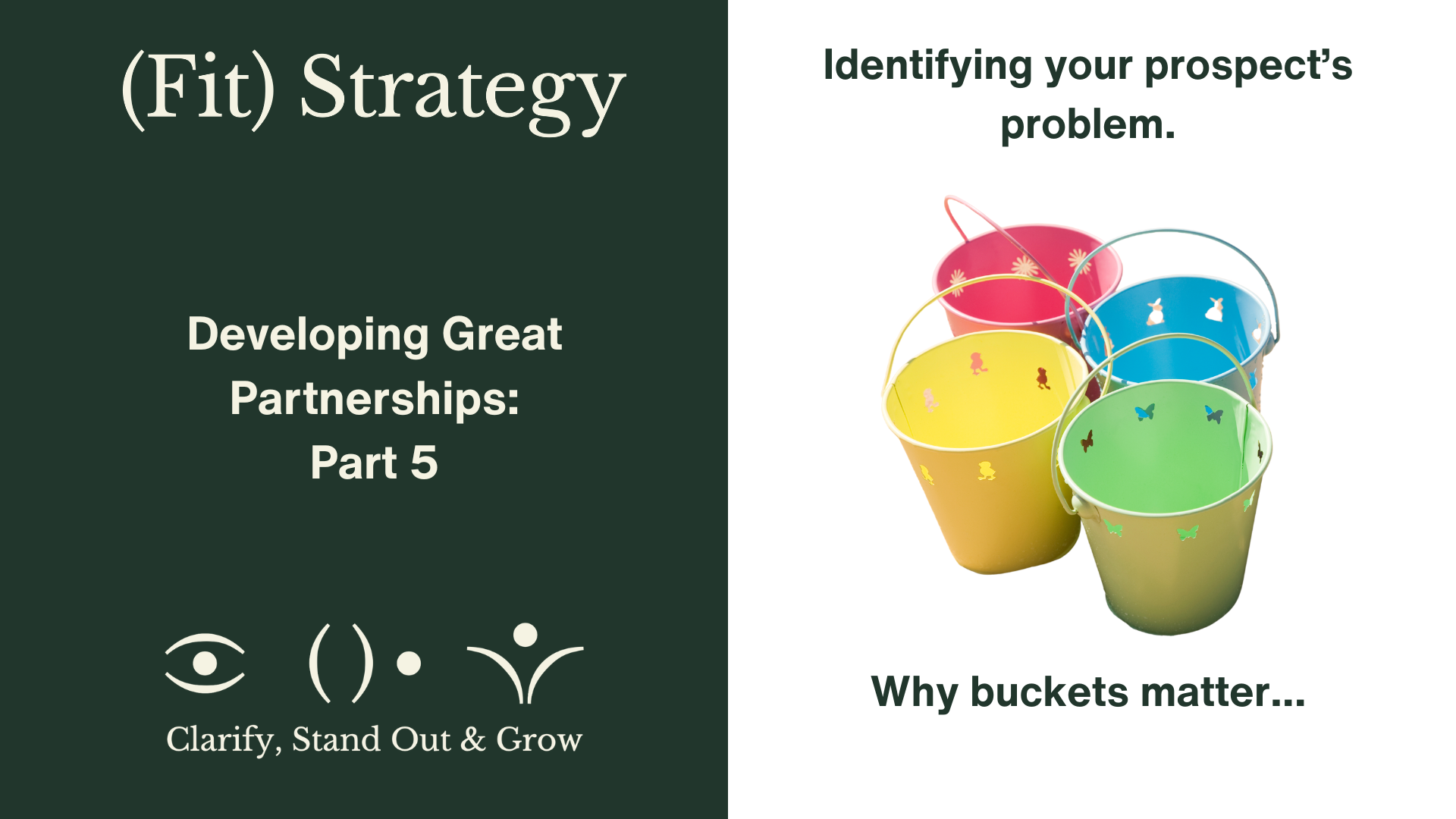
Identifying your prospect’s problem. Why buckets matter.
Yes, in partnership prospecting, buckets matter. More on that later.
Firstly, the artform of partnership prospecting involves finding someone who will exchange what you
want for what they want. They solve your problem and you solve theirs.
Bingo! A budding partnership.
That sounds simple. It rarely is. Here’s what has to happen if you are the initiator or seeker of the
partnership:
1. Know what you need from partners to make the impact you plan
2. Know who’s got that (ideally they have it in abundance)
3. Understand what their needs or problems are
4. Solve those needs with what you have (ideally you have it in abundance)
Point 3 is the hardest, because it won’t always, if ever, be that obvious. You need to dig for it.
And once you’ve discovered what they need, the next question is, where that need or problem sits in their organisation, internally or externally. Generally, but not always, the big problems, like reputation or audience growth, are external.
External ‘problems’ will fall into one or more of four buckets and are aligned to the phases a brand goes through to grow:
· Awareness – Do our target audience know who we are? yes/no
· Understanding – Do they understand what we do? yes/no
· Conversion – Do they support us? yes/no
· Retention – Do they continue to support us? yes/no
Let me put this into context – a solar farm developer needs greater social licence in a specific territory to proceed with their project. Their problem is in the Understanding bucket, i.e., the community is aware of the project but require a more compelling picture of it before they can support it. The developer is struggling to get quality access to the community to tell their story.
A partner that can help drive greater understanding and therefore deliver an uplift in positive sentiment towards it will be of incredible value to the developer. In turn, that partner will be in the box seat to negotiate for what will help with their own needs.
Let’s simplify the solution. After doing her due diligence, the president of the local football and netball club approaches the solar farm developer about sponsoring the club by upgrading the clubhouse solar system in return for giving the developer brand support and opportunities that will allow direct access to the community. Win-win. Also, note that each party delivers what they have in reasonable abundance.
Moving on, the bigger the problem, the more the prospect will give in return for a solution.
Here’s an example of a big problem:
Look at the many 000 outages across the telco industry. Imagine you met with one telco CEO, after the initial outages were solved, and asked:
You: What problems do you have now that you’ve fixed the original issue
CEO: Reputational, we are losing existing clients – massively. We can’t advertise our way out of it. We need a credible partner to help steady the ship.
You: Losing customers, declining trust, that’s a retention issue. So, what would you exchange for me to fix your retention problem?
CEO: Whatever you want.
Not all problems are this big, or this hard to solve, but you get my drift. Understanding a prospect’s problem is fundamental in building a meaningful partnership.
So, if you are in the business of partnership development, know your buckets.
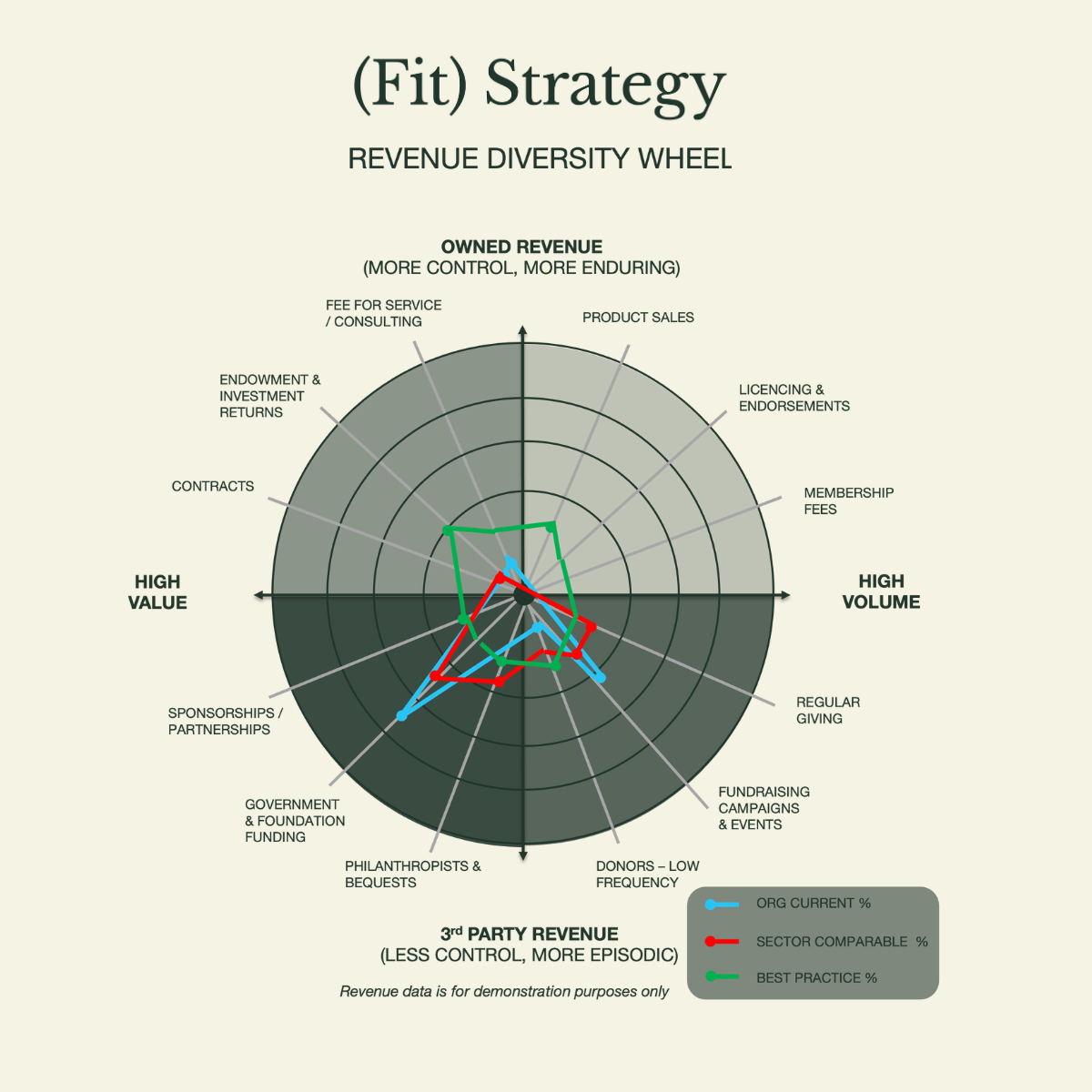
Revenue Diversity — Clarity for Non-Profits & For-Purpose Organisations.
Nov 2025
We’re excited to share our newest tool designed for CEOs and Boards who want a clear, immediate picture of their revenue mix and competitive positioning.
The Revenue Diversity Wheel gives leaders insight into where their income sits today, how it compares with sector norms, and where the opportunities are for greater control and sustainability.
Already, it’s helping clients benchmark their current position, identify vulnerabilities, and align their teams around a practical plan for diversified growth.
Building revenue diversity shouldn't be a mystery; it’s a process, and it’s open to every organisation ready to take the next step.
Should Non-Profit Boards Be Paid?
Aug 2025
This is a topic worthy of consideration.
Firstly, some general facts we do know:-
NFP Directors have more complex roles than their for-profit counterparts:
Their focus on purpose or mission is far greater and more intertwined with impact beyond
financial outcomes
The complexity of governance is increasing for Boards and Board members with the
heightened attention on ESG
They often have multiple stakeholder groups to manage, not just shareholders & staff
On average, NFPs generate only 18% of revenue from commercial activities; therefore,
82% comes from other stakeholders
Their consumer (user) and customer (payer) can often be different, bringing multi-dimensions to marketing, acquisition and retention priorities, as well as critical success metrics
The overwhelming majority of Board members are not paid for their services
Time commitment is increasing, with the clear majority dedicating more than a day each month to NFP Board work, with 46% more than 3 days, and 20% more than 6 days.
I could stop here and say there is already ample justification to find and reward the best talent for non-profit boards. It’s hard work, getting harder and more specialised.
According to the AICD, the number 1 challenge for Boards post-COVID-19 was the diversification of income. That’s a specialised skill if ever there was one.
Here’s some more data courtesy of AICD’s NFP Survey:
50% of all NFP board members are unpaid
26% are unpaid but get expenses covered
22% are paid
81% of NFPs have not discussed the option of paying board members
Development & Housing (39%) & Health & Residential Aged care (35%) are the highest sectors likely to be paying Board members
Arts/Culture/Sports (6%) is among the lowest sectors paying Board members
Of those paying, the average salary is $22,581 per Board member.
Whilst payment is not the be-all and end-all of ensuring Board performance, we believe it should be seriously considered for many non-profit Boards. Board members are no less important than the executive team. They aren’t there to fill up numbers. They have a critical, indispensable role to play in the development and oversight of an organisation’s strategy.
And whilst the trend, both here and in the USA, is moving towards paying Board members, there is a mindset and culture to overcome (and yes, in some organisations, a constitutional barrier). Culturally, we still think Non-Profits are a training ground and/or that we can’t afford to pay Board members. Yes, volunteers have a huge and precious role to play in NFPs, but Board members are the ultimate and final people responsible and liable for the professional stewardship of an organisation. Our non-profit sector is not and should not be for learner drivers.
Go with me here for a bit. With Board rotations coming up every 2 or 3 years, there’s a constant demand for people to fill empty seats. The challenge is, those most likely to step up time and again are those passionate about, or connected to the cause – someone with lived experience of the cause impact or, in an Association, a member. But does that qualify them to bring the insights and experience to grow and or govern the business? I know it’s not always the case and some amazing Board Directors are doing equally amazing jobs for knicks, but every seat needs to be filled, and that’s a slog and a risk.
Is that what happens in the commercial space? I think not, for sure. The commercial space will pay for Board members because:
They want the best people
They want to dictate the diversity of skills, gender and culture they think they require to perform well
They want to be able to hold someone accountable.
Performance and accountability in non-profits matter just as much, arguably more. If you think you can’t afford to pay your Directors, ask yourself why you must pay your CEO.
Ultimately, compensating NFP Board members isn’t about diminishing the sector’s value or values —it’s about empowering it to achieve its mission with the best possible leadership.
Breaking The Scarcity Mindset.
Jan 2025
Have you ever thought about the unfair constraints we impose on non-profits,
the uneven playing field compared to the commercial sector? It’s a conversation worth having.
For decades, we’ve burdened non-profits with a scarcity mindset—a framework that prioritises
frugality and minimalism at the expense of growth, innovation, and impact.
The Scarcity Trap
Unlike for-profit businesses, which are encouraged to take risks, invest in innovation, and reward talent,
non-profits operate under restrictive expectations. Consider these prevalent attitudes:
Frugality as a Virtue: Society values frugality in charities, often mistaking low spending as a measure of effectiveness.
Overhead Obsession: We hyper-focus on overhead costs, using them as an unfair proxy for performance while ignoring the broader impact achieved.
Cost Fixation: The emphasis on cost control overshadows discussions about revenue generation and long-term sustainability.
Dollar Efficiency over Impact: We scrutinise how every dollar is spent rather than assessing the overall volume and magnitude of results delivered.
Risk Aversion: Non-profits are discouraged from taking risks, even when the potential for high-impact outcomes exists.
Disconnect from Market Performance: Non-profits are rarely evaluated with the same competitive and market-based metrics that drive success in the commercial sector.
Talent Undervaluation: High-performing executives in the non-profit world are penalised for earning competitive salaries, and we balk at compensating board members despite the need for top-tier talent.
A Double Standard
Why do we treat the impact sector—arguably the most crucial one to get right—as a proving ground for talent or a pipeline to feed the for-profit domain? This mindset creates systemic inertia, where organisations struggle to move forward due to insufficient funding. In the commercial sector, lack of funding rarely halts progress. Companies find alternatives—whether through monetising their strengths, securing investment, or innovating their way out of challenges.
When non-profits attempt bold initiatives and fail, the narrative shifts to one of waste: “They squandered our money.” Meanwhile, for-profits can allocate billions to R&D, with failure regarded as part of the innovation process—an “investment” consumers ultimately pay for.
The Role of Media and Government
This scarcity mindset is perpetuated by governments and amplified by the media. Non-profits are held to a different set of rules, which often leads to stagnation. Overhead becomes the villain, while impact—the very reason for the organisation’s existence—takes a backseat. This dynamic acts as a brake on growth and prevents organisations from reaching their full potential.
A Call for Change
Dan Pallotta's documentary, Uncharitable, highlights these issues brilliantly. His argument focuses on the obsession with overheads and how prioritising cost-efficiency over impact is counterproductive. It should be required viewing for non-profit CEOs and board members.
However, the scarcity mindset runs deeper than overheads. It permeates non-profits’ cultures, strategies, and day-to-day operations. In our decades of working with the impact sector, we’ve observed this mindset—and its consequences—up close.
Towards a Balanced Approach
While some NFP organisations lean too far into commercial practices and risk losing the intangible value and trust that underpin many non-profits, the majority are still shackled by scarcity thinking. The balance lies in empowering non-profits to:
Invest in Growth: Encourage risk-taking and innovation to achieve meaningful, scalable impact.
Reward Talent: Pay competitive salaries and attract the best leaders and board members.
Think Commercially: Shift energy away from “asking” for funds to “earning” revenue through sustainable models.
Measure Impact, Not Overheads: Evaluate success based on outcomes and long-term change, not arbitrary financial ratios.
Conclusion
If we want the impact sector to thrive, we need to dismantle the scarcity mindset and replace it with a more expansive, commercial way of thinking. Non-profits should be free to innovate, grow, and attract top talent without fear of criticism. By shifting our collective expectations, we can create a thriving impact sector that generates profound, lasting change.
Why Non-Profit CEOs Should Be Wary of Corporate Sponsorship
Aug 2024
It’s every Not-For-Profit CEO’s dream… to snag a 6-figure sponsor. But here’s 3 reasons why they should be wary of it:
It’s elusive
It’s distracting
It’s unscalable
Perhaps a somewhat ‘interesting’ view coming from an organisation that led the non-sports sector in brokering sponsorships for 2 decades. But it is our very firm, experienced view.
So firstly, it’s elusive. The long corporate planning cycles, the various financial year windows in which to approach corporates, the poor remuneration for NFP sponsorship Managers, the high staff turnover and therefore the lack of experience in the sector (largely blame tier 1 sport), plus the difficulty in fashioning an ROI for sponsors makes meaningful sponsorship highly elusive.
Next, it’s distracting. NFPs generally don’t have the bandwidth to dedicate resources to non-core activities. The ROI demands of corporate sponsors can often be resource-depleting and counter-productive to BAU activities. Moreover, it is often much more difficult to integrate a sponsor than, say, in most major sporting codes. There are all sorts of hurdles to overcome: brand fit and integrity, audience alignment, activity appropriateness, corporate behaviour, audience perceptions, and so on.
But the big one for us is the lack of scalability to corporate sponsorship. Unless you have an existing platform, such as a conference, expo, or the like, every sponsorship you negotiate will be unique. So, you have to invest heavily in the early days to build something bespoke to address each and every sponsor’s individual challenge, and just when you start getting it right, you are up for renewal, likely with a whole new set of demands that you may or may not be able to meet.
Some NFP’s break the mould, generally the big brands that are largely rewarded for their brand health and the halo it brings for corporates. But for the very many that aren’t number 1 in their category, the golden rule is: It must directly enable your core business—help build your brand, acquire new audiences, and scale your core products and services.
So, if you do pursue corporate sponsorship, do it with eyes wide open, be focused on your human resource allocation and priorities, selective in who you court, and single-minded in what determines a ‘good fit’. It’s also not such a bad thing to stick to your core BAU knitting and just look for ways to grow it with greater scale.